
George County Parole vs Probation
Mississippi Department of Corrections defines probation as a court-ordered alternative to confinement that is monitored by a probation agent. Parole is a discretionary early release from an MDOC prison sentence. A George County parolee has left secure prison custody, but the MDOC sentence and supervision continue. A person on probation may never have served a prison term. That difference controls which record can verify the status.
The MDOC supervision types provide the clearest official starting point. A court order is central for probation because it creates the probation term and sets its conditions. An MDOC record and Mississippi State Parole Board action are central for parole because the Board grants or revokes parole while MDOC administers field supervision.
| Point | Parole | Probation |
|---|---|---|
| How it begins | Board grants supervised early release from an MDOC sentence | Court orders supervision as an alternative or part of the sentence |
| Best public record | MDOC parolee search, then MDOC or Board confirmation | Sentencing order and local supervision office confirmation |
| Public search limit | Shows active parole records, not a full history | MDOC parolee search is not a probationer locator |
| How it ends | Final discharge, sentence expiration, or other official action | Court-defined completion or other lawful court action |
- Parole
- Supervised release from secure custody before an MDOC sentence fully expires.
- Probation
- Court-ordered supervision that may be imposed without a prison term.
- Discharge
- The formal end of the applicable sentence or supervision term.
- Absconder
- A person alleged to have stopped required contact or left supervision without permission.
Verify George County Post-Release Supervision
Start with legal custody. A person who disappeared from the George County current roster may have been released, transferred, or removed after a data change. That event alone does not establish parole or probation. For an MDOC prisoner, use the state systems. For a local probation question, use the sentencing court and George/Greene field office.
- Confirm the person and custody episode with a full name, date of birth, MDOC number, booking number, or court cause number.
- Search the MDOC parolee interface by MDOC number or name. Add George County or Lucedale when it helps narrow the match.
- Compare the ID, name, location, and offense on the result. Do not rely on a name alone.
- For probation, obtain the sentencing or probation order from the court that handled the case because the parolee tool does not search probationers.
- Contact the George/Greene Probation & Parole Office when a result is unclear or current local reporting needs confirmation.
- Ask MDOC Records or the Parole Board for the appropriate status record when the public interface cannot answer a historical or discharge question.
The state search is useful evidence, but it is not a full supervision history. The sheriff release record proves the end of county custody. MDOC proves state custody and parole. The court order is the key source for probation. A person-specific George County released inmate search starts with those distinct record owners rather than treating one database as universal.
George County Parolee Search Fields
MDOC permits searches by first name, last name, MDOC ID, city, and county. George appears in the county selector. The results grid then shows the ID number, name, location, offense, and a link to view the record. Those fields can separate people with similar names and connect a result to the correct MDOC case.
The county and city filters narrow an active parole search; they do not create an archive of all people released in George County. Location may describe supervision, not the place of release. Likewise, the offense field helps match identity but does not state the supervision end date. A result should be read with the release record and any controlling order.
The official MDOC parolee search screen shows the state lookup available for George County.
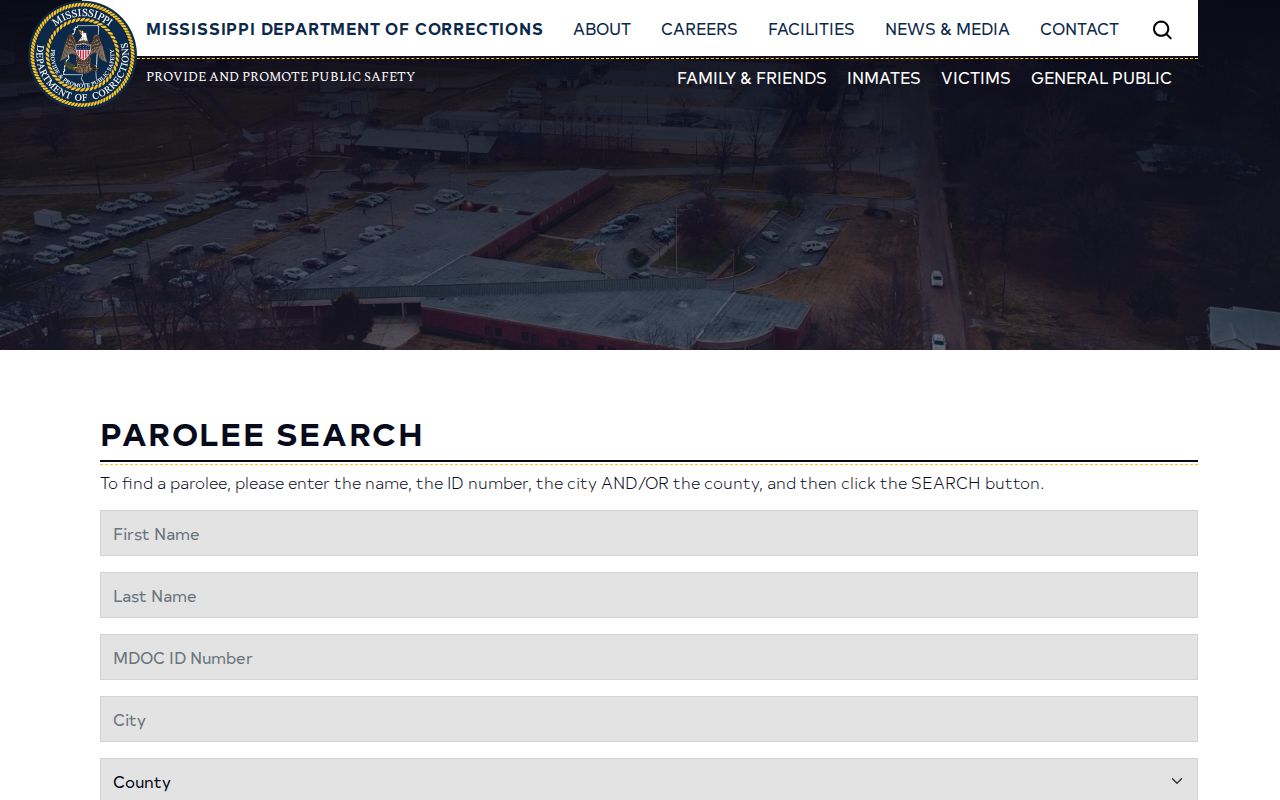
Use the screen for an active parole check, then confirm uncertain or older supervision status with the responsible MDOC office.
Note: The parolee interface is not a probation search, public warrant list, hearing calendar, or complete final-discharge archive.
George County Supervision Office
George and Greene counties share a named MDOC field office in Lucedale. The George/Greene Probation & Parole Office is the local human-verification route for current supervision, subject to identity checks, confidentiality rules, and limits on what staff may disclose. It should be contacted after the record type is known.
George/Greene Probation & Parole Office38 London Street, Suite A
Lucedale, MS 39452
Phone: 601-947-3479
Fax: 601-947-6415
When calling, provide the full name and MDOC number if known. Ask whether the office is the proper contact for the identified supervision record. Do not ask staff to infer release from a missing county roster entry. First establish the MDOC parole status or court-ordered probation term.
The official local office page confirms the shared George/Greene supervision location.
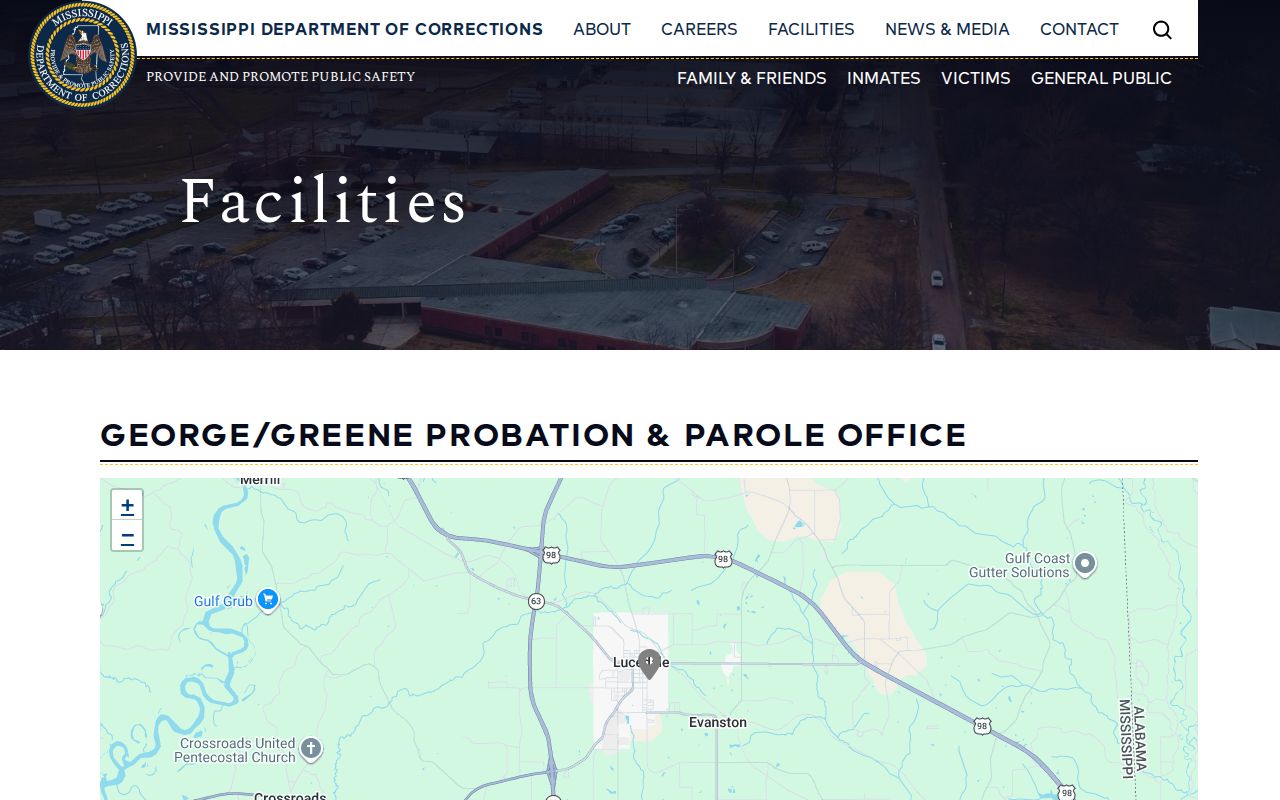
This office listing provides a direct local route when an online parole result or a probation order needs current agency confirmation.
George County Parole Hearing Records
The Mississippi State Parole Board has exclusive authority to grant and revoke parole. MDOC computes eligibility and supervises parolees. No verified public person-by-person hearing calendar or public decisions search exists. A claimed hearing date or result should not be checked against a portal that the Board does not publish.
Board Rule 2.1 states that hearings are closed. Staff sets the appointment and notifies legal representation. Rule 3.4 says a hearing should take place no later than thirty days before the eligibility month, allowing consideration in that month or the two months before it. A proceeding may involve file review, an in-person appearance, telephone, or teleconference. This cadence describes Board process, not a promised release date.
Written decisions go to the offender and victim or family under Rule 2.3. Disclosure to another person requires a stated reason and case-by-case review. Rule 3.4 also says the offender is advised after deliberation, and a denial action identifies the reasons and next-hearing set-off. The Mississippi State Parole Board contact listed by MDOC is the correct fallback for a properly framed status question.
Mississippi State Parole Board239 N. Lamar Street, Suite 501
Jackson, MS 39202
Phone: 601-576-3520
Email: MSStateParoleBoard@mdoc.state.ms.us
Note: Parole eligibility permits Board consideration; it does not establish a grant, actual release, or active George County supervision.
George County Absconder Status Checks
No official statewide public absconder or parole-warrant list was found. Mississippi rules permit a warrant based on a probable parole violation and address absconding in the supervision process. Still, a missing parolee-search result does not prove either fact. It may reflect completed supervision, spelling differences, a database limit, a move, or another status change.
Use the George/Greene office for a current supervision question, the Parole Board for parole status within its authority, and a current custody system if a return to confinement is alleged. Mississippi SAVIN/VINE may report release, transfer, return to custody following abscond supervision, escape, or an abscond-supervision event. Each label must be read as written. A transfer notice is not a community release, and an automated event should be confirmed with the reporting agency.
Conditions vary by order and case. High-level supervision may include reporting and compliance with Board or court directions, but the exact order controls. The public record should not be used to guess a violation. Obtain the official status or order.
George County Reentry Education
George County Regional Correctional Facility has a documented education component tied to reentry preparation. Mississippi Gulf Coast Community College entered an agreement to offer classes at the facility. A May 2026 graduation recognized fourteen high-school-equivalency diplomas and six construction-technology credentials. The reported total consisted of five certificates and one diploma in that trade area.
The MGCCC education agreement and the May 2026 graduation report supply local program context. They do not show that a named participant received parole, left custody, or reported to the George/Greene office. Program completion and legal release are separate facts. Parole must still be verified through MDOC, the Board decision, and the active supervision record.
This distinction matters at the mixed regional facility. Local detainees and MDOC prisoners can occupy the same building, while education may serve the state-prison population. A program credential does not identify the custodian or release mechanism. The record for the named person must do that work.
George County Supervision Discharge
Supervision ends through an official act or the lawful completion of its term, not merely because a web result disappears. For parole, Board Rule 3.5 requires reporting to the field officer within twenty-four hours after actual release unless directed otherwise, with continued reporting until final discharge. That creates a defined sequence: confirm actual MDOC release, confirm local parole supervision, then obtain proof of final discharge when the term ends.
Probation completion rests on the court order and the official supervision or court record. A parolee search is not the right tool for that question. If a person is no longer found online, request the record that states the end date and basis rather than drawing a conclusion from absence. The Mississippi Public Records Act permits access to nonexempt agency records under written procedures, but confidential field, victim, or investigative material may be withheld or redacted.
When records conflict, compare their dates and custodians. The sheriff documents the county custody episode. MDOC documents a state sentence, parole, earned-release supervision, or final discharge. A court documents probation and the legal order. Each office corrects its own record, so provide the relevant identifiers and certified orders to the office that owns the disputed entry. The official Mississippi Public Records Act page explains the state's request framework.