
George County Release Date Types
“Projected,” “tentative,” “eligible,” and “actual” describe different points. MDOC’s official public field is “Tentative Release Date.” The department defines it as an anticipated date after adjustments for earned time or jail credit. “Maximum Discharge” is the expected sentence endpoint without early-release allowances. Parole eligibility is only the point when an eligible person may be considered for a Board decision.
A George County pretrial detainee usually has no sentence-based release date to calculate. Release may depend on bond, a court order, dismissal, case outcome, or another hold. A locally sentenced person may have a jail term described in the court order, but the sheriff and court must confirm the applicable credit and actual departure. A state prisoner housed at the George/Greene County Correctional Facility remains under MDOC authority even though the sheriff operates the building.
| Date | Meaning | Best source |
|---|---|---|
| Tentative release | An anticipated MDOC date adjusted for eligible credit and earned time. | MDOC detail record and MDOC Records |
| Maximum discharge | The sentence endpoint described without early-release allowances. | MDOC time sheet and sentence record |
| Parole eligibility | A chance for consideration, not a grant or release. | MDOC computation and Parole Board rules |
| Actual release | The date custody truly ended or shifted into a release status. | Sheriff or MDOC release record |
Lookup George County Release Dates
Begin with legal custody, not the building name. For an MDOC prisoner, use the MDOC Inmate Search. It accepts first name, last name, or MDOC ID number. The number is the strongest search key. Results show ID, name, location, term, and offense. Open the detail view to reach the sentence and date fields.
- Decide whether the person is a local detainee, locally sentenced person, or MDOC prisoner.
- For MDOC custody, search by MDOC number or full name and compare identity details.
- Open the detail record and note location, county of conviction, sentence data, and Tentative Release Date.
- For local pretrial custody, obtain the controlling bond or court order and check for other holds.
- For a local jail sentence, compare the commitment order with the sheriff’s custody record.
- Ask the proper records office to confirm the latest calculation and actual event.
The George County current roster does not publish a release date. Its disappearance cannot distinguish release from transfer, data correction, or movement into MDOC. For a local episode, call the regional facility at 601-947-9399 and seek the written release or transfer record. The full George County release-record process covers the sheriff request and court paths.
The manifest capture of an MDOC detail record demonstrates where the exact “Tentative Release Date” label appears.
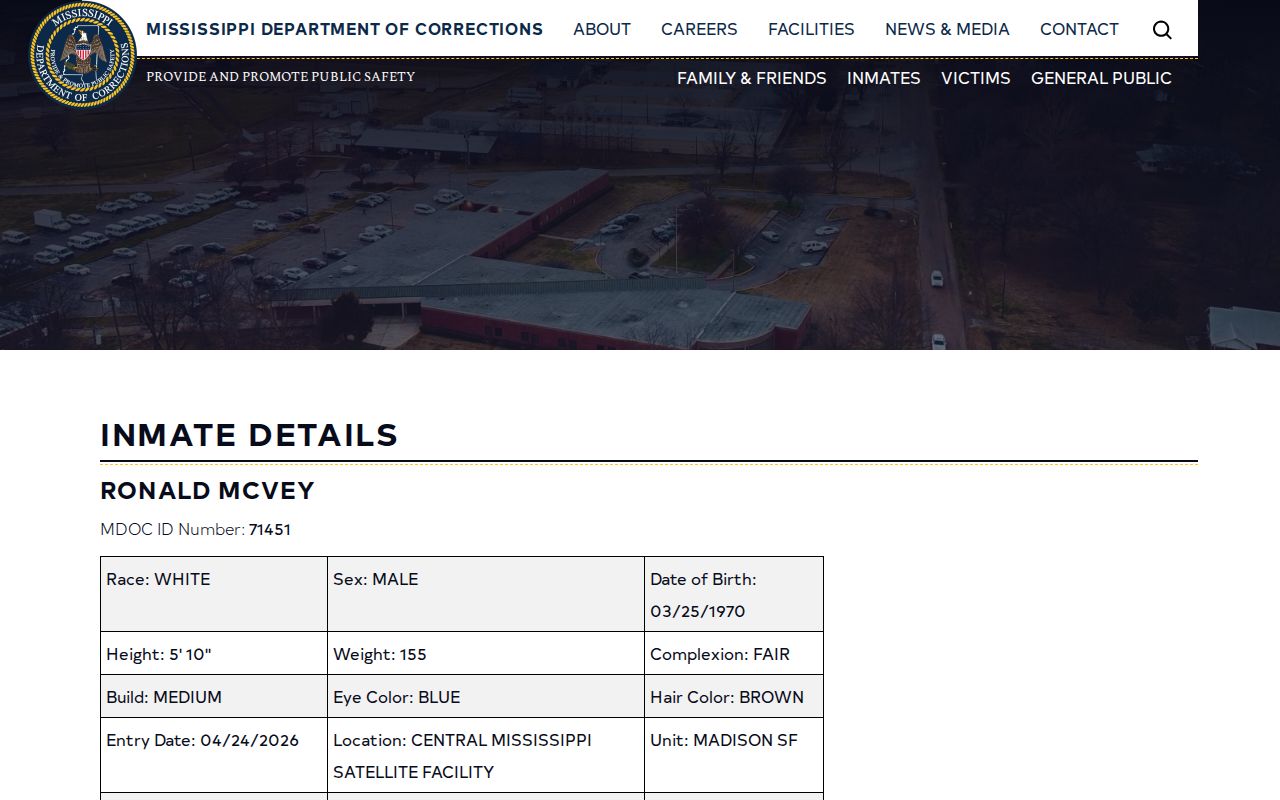
The pictured record is a field example, not proof that the displayed person has been released.
Note: A location change on an MDOC record may show a transfer, so read location and date fields together.
George County Earned Release Time
Mississippi Code §47-5-138 governs MDOC earned release supervision. For eligible sentences imposed after June 30, 1995, subsection (5) permits 4.5 days of earned time for each thirty days served for good conduct and performance. The reduction is capped at fifteen percent of the sentence. That cap creates the familiar shorthand of about eighty-five percent served.
The shorthand is not a personal release calculator. Eligibility differs by sentence and controlling law. Serious rule violations can cause forfeiture under subsection (2). Jail credit, sentence structure, later orders, and other lawful factors also affect the MDOC computation. A calendar estimate made by subtracting fifteen percent does not establish an official tentative or actual date.
Subsection (6) places an eligible early release into earned-release supervision, often shortened to ERS. The person remains an inmate under MDOC jurisdiction until the sentence expires. If ERS is revoked, subsection (7) requires the remainder to be served and does not credit street time against it. Release from secure confinement and final discharge are therefore not the same status.
- Earned time
- An eligible sentence credit awarded under MDOC rules and state law.
- ERS
- Earned-release supervision outside secure confinement while MDOC jurisdiction continues.
- Maximum discharge
- The outside sentence endpoint described without early-release allowances.
- Jail credit
- Eligible time in county custody that MDOC may apply to the same cause after verification.
George County Jail Date Limits
Do not apply the MDOC earned-time statute automatically to a purely local George County jail sentence. Section 47-5-138 is an MDOC provision. For a county sentence, obtain the commitment or sentencing order and ask the jail or court what credit is authorized. The current county roster provides booking facts and photographs, not a projected-release field.
If the person is committed to MDOC, the state computes eligible jail credit. MDOC’s handbook says qualifying credit generally concerns pre-sentence county time tied to the same cause. It also tells prisoners to alert case managers about time spent in another location. A George County booking date alone cannot show how much credit MDOC accepted, especially when several causes or jurisdictions are involved.
MDOC Records handles questions about offender time, jail credit, and eligibility dates. The office lists P.O. Box 24388, Jackson, MS 39225; 601-933-2889; and MDOCRecordsDepartment@mdoc.state.ms.us. Ask for the nonexempt time sheet, sentence begin and end dates, posted jail credit, tentative date, eligibility dates, and actual release or discharge fields. State the MDOC number and cause number when known.
George County Dates Can Change
A projected date changes when the facts used in the computation change. Some changes move the date earlier, while others move it later or replace one type of release with another. The public MDOC interface may not yet show a recent court order, new credit, or disciplinary decision. Detainers can also affect what happens on the anticipated date even when the sentence computation itself remains accurate.
| Factor | Possible effect | Record to check |
|---|---|---|
| Earned-time accrual | May advance an eligible tentative date within the statutory cap. | MDOC time sheet |
| Earned-time forfeiture | May move the expected date later. | MDOC disciplinary and time records |
| County jail credit | May change the term after qualifying dates are verified. | County custody log and MDOC computation |
| Concurrent or consecutive terms | Changes how two or more sentences run. | Sentence orders and MDOC time sheet |
| Amended court order | Can alter the sentence facts MDOC must apply. | Certified court order |
| Detainer or hold | May cause transfer instead of community release. | Custodian and receiving-agency records |
| Parole or ERS decision | Changes the legal route from confinement to supervision. | Board or MDOC record |
Parole percentages deserve the same care. Mississippi’s rules use different eligibility formulas and list exclusions, but eligibility only permits consideration. It does not show that the Board granted parole. The Board can deny release, and a grant can still depend on lawful release planning and other conditions. A parolee-search result supports active parole, while a miss proves no single outcome.
George County Parole Date Limits
Parole eligibility is separate from earned-time arithmetic. Mississippi Parole Board Rule 3.1 summarizes different eligibility points for eligible nonviolent, violent, named serious violent, and nonhabitual drug offenses. It also lists exclusions. The law tied to the offense date, sentence, and status controls. A percentage cannot be applied safely without the official classification and MDOC computation.
The Mississippi State Parole Board decides whether to grant or revoke parole, while MDOC computes eligibility and supervises parolees. No verified public person-by-person hearing calendar or decisions-search portal exists. Closed-hearing rules and individualized decision notices mean an online calendar miss cannot confirm that no hearing occurred. Contact the Board or use an appropriate records request when the public MDOC fields do not resolve the question.
Even a grant does not equal the exact time someone walks out. Release planning, a detainer, another sentence, or another lawful condition may affect the event. After actual release, the rules generally require reporting to the field officer within twenty-four hours unless directed otherwise. The supervision record can support a later parole check, but the MDOC release record remains the source for the state custody exit.
Who Computes George County Dates?
MDOC, not the George County sheriff, computes an MDOC prisoner’s tentative, ERS, parole-eligibility, and maximum dates. That rule holds even when the prisoner is housed at the sheriff-operated regional facility. The building’s mixed role can make the roster look local while the legal sentence remains entirely in the state system.
Eligible jail credit is cause-specific, and earned time under §47-5-138 is capped and subject to forfeiture. That makes an unofficial eighty-five-percent calculation too weak for confirmation. Use it only to understand the statutory ceiling. The official date comes from MDOC’s records and current computation under the law tied to the offense and sentence.
A local detainee follows another route. The court supplies the legal authority, while the sheriff record supplies the physical release or transfer time. If another hold exists, the end of one George County case may lead to another custodian instead of freedom. Always ask whether the projected event is release, parole, ERS, maximum discharge, or transfer.
Note: Placement at the George County facility does not decide who computes the date; legal custody and the sentence source do.
Confirm George County Release Dates
Check the record again near the anticipated date. Then contact the responsible records office. For MDOC, ask whether the Tentative Release Date is current and whether detainers, sentence changes, or pending decisions affect it. For county custody, ask the facility whether the named episode ended and whether the person left custody or transferred.
VINE can add a custody-change alert, but it does not replace the release record. Registering through the George County VINE inmate check can provide notice of release, transfer, or other tracked changes. Read the event literally and confirm it with the reporting agency.
The final proof should match the question. Use the sheriff’s release timestamp for an ended local stay, the court order for legal authority, and the MDOC release or discharge record for state custody. Keeping those records separate avoids treating a forecast as an event or a transfer as community release.